• Skip to primary navigation
  • Skip to main content
  • Skip to primary sidebar
  • Skip to footer
Cross Product Calculator ( Vector )

Cross Product Calculator ( Vector )

  • Home
  • Cross Product
    • Cross product Problems
    • Dot product vs Cross product
  • Calculator
    • How to use cross product calculator?
    • Why do need a cross product calculator?
  • Dot Product

Admin

Dot Product vs Cross Product

When studying technical subjects like physics or mathematics, one of the most common questions we find ourselves asking is, “Why should we study this and how is it going to help us in the future?”

I’d love to answer this question for you. The truth is, every aspect of the subjects you learn have some or the other application in your real-life, be it skill wise, content wise, or simply as a matter of gaining an attribute.

A common topic that every student would despise getting into, is vector algebra. Although it may look tricky at face value, in this article we’re going to cover the difference between cross product and dot product. Before we step into it, let’s understand what vector algebra is and how its study can be beneficial.

Vector algebra, as its name suggests, deals with vectors. Most quantities are either scalars or vectors. Scalars only have magnitude whereas vectors have both magnitude and direction.

Now that we’ve understood the importance of vector algebra, let’s get into dot product and cross product specifically.

Difference between cross product and dot product

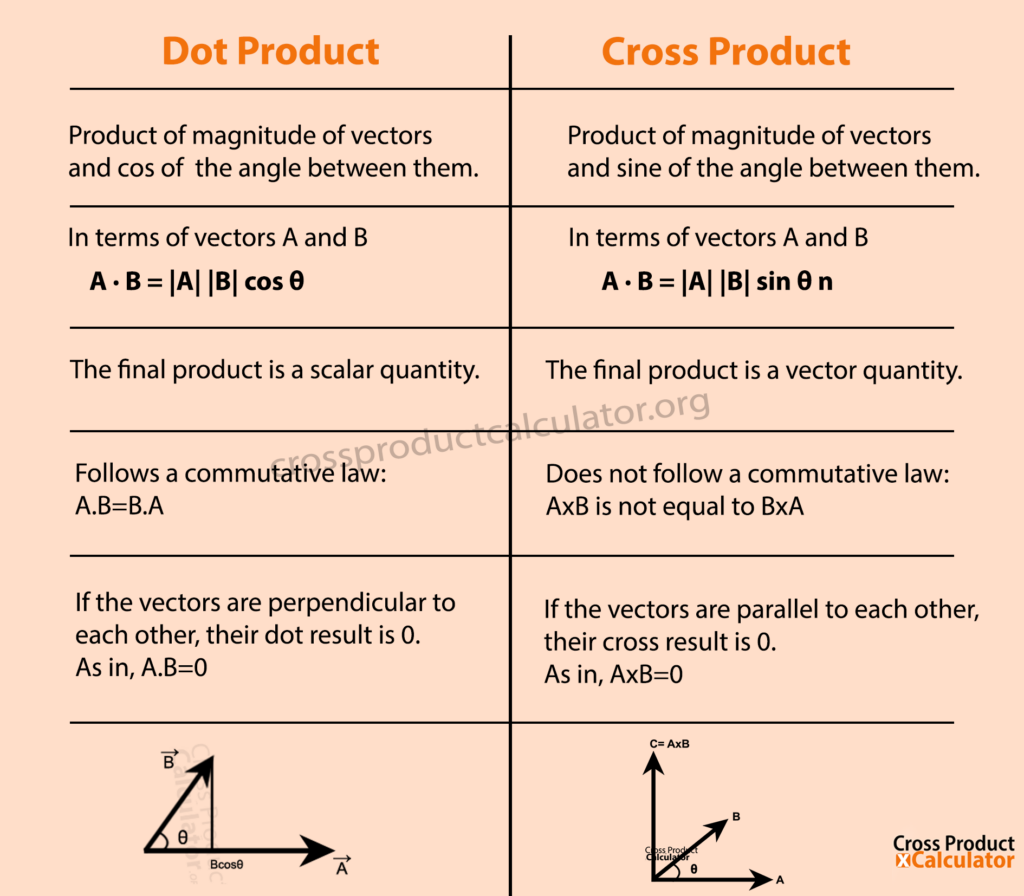
1. The main attribute that separates both operations by definition is that a dot product is the product of the magnitude of vectors and the cosine of the angles between them whereas a cross product is the product of magnitude of vectors and the sine of the angles between them.

2. While this is the dictionary definition of what both operations mean, there’s one major characteristic that segregates them both. That difference can be noted in terms of vector algebra. The result of a dot product is a scalar quantity with magnitude as its whole, however, the result of a cross product is a vector quantity with both magnitude and direction.

These are the two main differences you must take note of to understand the concepts at face value.
Let’s take a mathematical approach to get familiar with it a bit more:

A dot product is represented the following way:

 a . b = ||a|| ||b|| cos (θ)

Here A and B are vectors and is the angle between both vectors.

A Cross product is represented the following way:

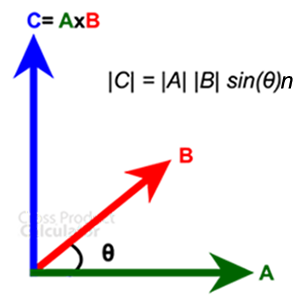
 a . b = ||a|| ||b|| sin (θ) n

Here A and B are vectors and is the angle between them. N is the unit vector perpendicular to the plane that A and B are a part of.

DOT PRODUCT VS CROSS PRODUCT (Tabular Form)

This will give you a summed up idea of the differences between both operations, in simpler words.

Factors of ComparisonDot ProductCross Product
General DefinitionProduct of magnitude of vectors and cos of the angle between them.Product of magnitude of vectors and sine of the angle between them.
Mathematical FormulaIn terms of vectors A and B

A · Β = |A| |B| cos θ
In terms of vectors A and B

A × Β = |A| |B| sin θ n
ResultThe final product is a scalar quantity.The final product is a vector quantity
Result With further explanationScalar: Only Magnitude.Vector: Both magnitude and direction.
Property 1: CommutativityFollows a commutative law:
A.B=B.A
Does not follow a commutative law: AxB is not equal to BxA
Property 2: Orthogonality of vectorsThe dot product is zero when the vectors are orthogonal, as in the angle is equal to 90 degrees.
What can also be said is the following:

If the vectors are perpendicular to each other, their dot result is 0. As in, A.B=0
Whereas, the cross product is maximum when the vectors are orthogonal, as in the angle is equal to 90 degrees.
What can also be said is the following:

If the vectors are parallel to each other, their cross result is 0. As in, AxB=0
Property 3: DistributionDot products distribute over additionCross products also distribute over addition
Property 4: Scalar Multiplication LawScalar Multiplication Law is followed by Dot ProductsScalar Multiplication Law is also followed by Cross Products

What does this mean theoretically?

 Dot Product :

Due to having only magnitude and no direction, both vectors in a dot product operation are aligned the same way. The cosine of the angle between these vectors is taken. The product comes out to be scalar. It is also known as inner product or projection product.
Dot productThe product has 4 distinct properties known as commutative, distributive, orthogonal, or one that follows the scalar multiplication law.

Applications of Dot Product:
The operation is used to define the length between two points on a plane, with known coordinates.

Cross Product :

Due to having both magnitude and direction, the magnitude of the vectors is taken along with the sine of the angle between them. As a result, the product comes out to be a vector quantity. It’s important to note that the final result of the cross product operation must be perpendicular to both vectors, or in other words, the plane that both vectors lie on.
cross product - crossproductcalculator.org

Thus, the right-hand thumb rule can be used to find the direction. In that case, the two fingers represent the vectors and the thumb determines the product. A cross product is also known as directed area product.

Just like the dot product, cross product also has 4 distinct properties. It is non-commutative, distributive, orthogonal, and compatible with the scalar multiplication law.
Applications of Cross Product:
Mainly applied in computational geometry to find or define the distance between two skew lines. Cross product can also be used to suggest if two vectors are coplanar or not.

dot product vs cross product

Conclusion:

Vector algebra that covers dot and cross products is a beneficial topic for aspiring physicians and mathematicians as it gives an insight into basic geometry and trigonometry that can be applied in real-world situations. In mathematics, addition, subtraction, and multiplication on vectors can be performed to understand the nature of a plan or trajectory, whereas in physics, vectors like distance, displacement, velocity, and acceleration are used to understand more extreme subjects.

Euclidean’s vectors have been used for several hundred years now, making a lot of contributions to the math and physics sectors. They were analyzed, evaluated, and reworked on after several scientists and mathematicians developed the concept, making alterations and innovations as new information would come into the picture.

Once understood, vectors can be an interesting topic to further your study on, and also apply in your life. We hope this article on dot and cross products helped you to understand the basic differences in terms of formula, properties, and applications!

Dot Product

Calculus is a complex part of Math. Even genius minds need to understand its core fundamentals to grasp this branch of arithmetic.

To calculate the position of anything that exists and has dimensions, cross product and dot product are used. These consider the coordinates of the number of dimensions, their magnitudes, and directions, finally giving the exact position.

This is done to define a particle’s address in the unlimited space around us. Let’s take, for instance, an electron.

It is so minute that you cannot calculate its location using centimeters or even millimeters. Also, it is inevitable to figure out the location without considering different dimensions because of its tininess.

Hence, Dot Product is what you need to get a pinpoint site of a nanoscopic particle.

What is a DOT PRODUCT?

With various directions and magnitudes, you need to consider when calculating the position of any particle/object in space (both two and three dimensions). Hence, these have been divided into two calculation types that will bifurcate separate calculations for easy understanding.

There are two lanes to go down; the first uses the cross product, whose product is again vector in nature. The second is using dot product, whose product is not a vector but a scalar.

Dot product

A scalar value is a number that gives a definite value, unlike a vector product that is not definite and is instead a variable. Although this difference is present, it does have the magnitude and direction of its product.

What is the Dot Product of Two Vectors?

Since its a product, it will involve two different values. So these are multiplied to get the final product.

Dot Product determines the similarity between the two selected values for calculation and not the difference between them like the cross product. Therefore, it can be both positive and negative in its value.

Let us consider two different vectors, a and b. The product between these two vectors, a and b, is called a ‘Dot Product.’

a . b = ||a|| ||b|| cos (θ)

  • a and b are the two vectors.          
  • θ is the angle between the two vectors a and b (ranges between 0° to 180°).

The angle between the two vectors is significant. This angle decides whether the dot product will be positive or negative (or bigger or smaller in value).

For example, let us consider two cases,
Case 1:
Let the θ value be ‘0’, meaning both the vectors overlap each other without the slightest discrepancy. They are perfectly aligned, pointing in the same direction.

So, the representation will become –  a . b = ||a|| ||b|| cos (0)

Cos (0) = 1

Therefore, whatever the value of a and b may be, now that the angle value is 1, the product between them will give the dot product a greater than 1.

The greater the dot product value, the similar will be the value of the direction of the particle/object in question.

Case 2:

Let the θ value be ‘1’, meaning both the vectors are perpendicular to each other precisely at right-angled positions. Thus, in the directional sense, if one points north, the other is pointing at east.

So, the representation will become –  a . b = ||a|| ||b|| cos (90)

Cos (90) = 0

Therefore, whatever the value of a and b may be, now that the angle value is 0, the product between them will be obviously 0.

Case 3:
How can a dot product be negative?
If the angle between them is cos (180), i.e., both the vectors are connected by one of their ends, pointing in opposite directions, then the value will indeed be 1, but with a negative sign before it. And so, the negative existence of dot product can be justified.

Dot Product Formula

There are two formulae, depending on the type of mode of calculation. The value will remain the same for both types, except for representation.

Algebraic Expression

A concise expression has been formulated for easy calculation. And that is –

Where, a is first vector
b is second vector
Σ is summation; it is the total of all the dimensional dot product values
n is the dimension number (n=1,2,3,……..)

Here, a1, a2, a3………an are all the values only concerning vector a, but in different dimensions, like

a1 is for x-axis,
a2 is for y-axis
a3 is for z-axis
And so on.
The same is the case for vector b.
Values of both a and b vectors are used to get the final product.

Geometric Expression

This expression, unlike the Algebraic Expression, involves the angle. Hence, θ holds much importance here.

The Geometric Expression is –  a . b = ||a|| ||b|| cos (θ)

Where, a and b are the two vectors.
θ is the angle between the two vectors, a and b.

Here, θ are mostly 0°,30°, 45°, and 90°, and their respective values are 1, √3/2, √1, and 1/2.

How to do Dot product?

To do Dot Product, there are two methods in Algebraic Expression. However, there can be more than two methods if there are more than two dimensions: three or four and so forth.

Two-Dimensional Dot Product :

The Algebraic Expression for a two-dimensional representation is –
a · b = ax × bx + ay × by

Where, a and b are the two vectors of which the dot product is to be calculated.

ax is the x-axis
ay is the y-axis

are the values of the vector a.

bx is the x-axis
by is the y-axis

are all the values of the vector b.

On solving the above expression, you will get the dot product of a two-dimensional particle/object.

Three-Dimensional Dot Product :

The Algebraic Expression for a three-dimensional representation is almost the same; save the addition of another dimension after x and y, i.e., z.

a · b = ax × bx + ay × by + az × bz

Where, a and b are the two vectors of which the dot product is to be calculated.

ax is the x-axis
ay is the y-axis
az is the z-axis

are all the values of the vector a.

bx is the x-axis
by is the y-axis
bz is the z-axis

are all the values of the vector b.

On solving the above expression, you will get the dot product of a three-dimensional particle/object.

Dot product Examples

Algebraic Expression

Two-Dimensional Dot Product

E.g. The coordinates for the x-axis and y-axis for the vectors a and b are given as (-4,8) and (3,6)

Solution: Substitute the coordinate values in the formula for the two-dimensional dot product.

Formula : a · b = ax × bx + ay × by

Substituting, we get –

a . b = (-6 × 5) + (8 × 12)

On solving, we get –

a . b = (-30) + (96)
a . b = -30 + 96
a . b = 66

Therefore, the dot product of vectors a and b is 66.

Three-Dimensional Dot Product

E.g. The coordinates for the x-axis, y-axis, and z-axis for the vectors a and b are given as – (4,8,10) and (9,2,7)

Solution: Substitute the coordinate values in the formula for the two-dimensional dot product.

Formula – a · b = ax × bx + ay × by + az × bz

Substituting, we get –

a . b = (4 × 9) + (8 × 2) + (10 × 7)

On solving, we get –

a . b = (36) + (16) + (70)
a . b = 36 + 16 + 70
a . b = 122

Therefore, the dot product of vectors a and b is 122.

Geometric Expression

E.g.  For vectors a and b, the values are 10 and 13. The value of θ is 59.5°

Solution: Substitute the values in the formula.

Formula – a . b = ||a|| ||b|| cos (θ)

Substituting, we get –

a . b = ||10|| ||13|| cos (59.5)

On solving, we get –

a . b = ||10|| ||13|| 0.5075
a . b = 10 × 13 × 0.5075
a . b = 65.98 which is almost 66

Therefore, the dot product of vectors a and b is 66. Now go back and compare the answer we got using Algebraic Expression.

You will observe that both the answers are ‘66’ irrespective of the method used. Hence it is proved that both the methods result in the same.

Conclusion

On a moderate level, the dot product is used in math and physics. On a larger scale, the dot product is used to study space, its components, what type of particles and objects are found, their dimensions, etc.

Therefore, the dot product is essential and significant for discovering the still hidden secrets of space.

Dot Product

Why do need a Cross Product calculator?

Why do need a Cross Product calculator?

Mathematics is ideally supposed to be fun as you number crunch your way to getting real-time results through the application of a formula or a technique; albeit, for many students, Math is not all that fun in reality. The reasons could be varied like the tiring mental mumbo-jumbo with numbers, the need to understand various formulae and how to apply them, etc. It is because of this many would love to have a calculator beside to help them out in solving many Math problems like, for instance, the Cross Product Calculator which is an online calculator for finding the cross product of two vectors.

How to solve vectors?
While there are two ways to solve vectors, it is essential to know that that they yield different types of results. When you find the dot product of vectors, the result is a scalar value whereas cross product of vectors gives a vector value. For a better understanding of how to solve vectors and cross products refer this article.

How to use the Cross product calculator?
The calculator is pretty simple to use, whether you need it for academic or personal use, you can simply key in the digits and press enter to find the solution. Cross Product Calculator also compares both dot product and cross product formulae and tells you why both are not similar in the operations. What’s more? You can use it to find the product of 2 and 3 vectors, which generally takes quite a while when performed manually.

How to use Cross product Calculator?

Vector cross products are essentially used in physics and mathematical problems. And there are known formulae that solve vector equations. Vectors have both magnitude and direction, but their result is always a scalar quantity.

Now, while every sum can be solved using the formula, the question is, should you? Should you spend your time being productive and resourceful or physically solve each problem? If these problems are a means to an end, then they are better solved using the Cross Product calculator.

How to use Cross product Calculator?

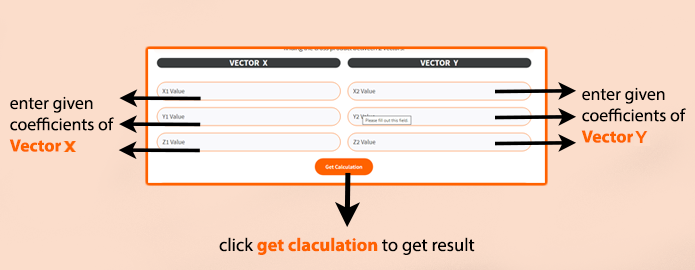
The calculator is pretty simple to use, whether you need it for academic or personal use, you can simply key in the digits and press enter to find the solution.

how to use cross product calculator

Follow the steps below to find out the cross product :

Step 1: Enter the given coefficients of Vectors X and Y in the respective input boxes.
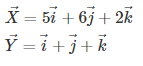
For example, if two vectors are given as crossproductcalculator.org
then you should enter 5, 6, 2 in the Vector X input boxes and 1,1,1 in the Vector Y input boxes.

Step 2: Click on the “Get Calculation” button to get the value of cross product between 2 vectors.

Step 3 : Finally, you will get the value of cross product between two vectors along with detailed step-by-step solution.

Cross Product Problems

Are you searching for cross product problems for better understanding? Wait! you are in the right place. In this article, we are going to explain the problems of the cross product.

Mathematics! The monster in every kids’ dream. The ‘yucky’ part of doing homework every day after school. The ‘ew’ is heard by the parents whenever they ask how their kids’ Maths class was. Indeed, these imply the distaste of it and so definitely, not everyone’s cup of tea.

To add to this comes the big bad guy – ‘Algebra’ to instill fear in the young kids. The stories they have heard from their older siblings: ‘Once Algebra starts for you, you are done for.’ ‘You don’t know basic multiplication. What will you do when Algebra starts, God, knows!’

Everyone has heard these dialogues at least once in their life during their school years, and the fear was indeed genuine. And true to its rumor, it did make us suffer in more ways than one.

But, the difference between now and then is that, in the world of advanced technology and the availability of an unlimited variety of audio-visual aids, we can now use a more practical approach for understanding.

To understand Algebra, a three-dimensional imagination (since space is three-dimensional) is a must, and thus it is difficult to explain on paper that it is two-dimensional. Hence, the difficulty was back then and the technology makes it easy now. For instance, We made a tool called Cross Product Calculator which is a free online calculator for finding the cross product of two vectors.

Now, let us begin from the basics of cross-product and slowly understand the problems of cross product.

What is a CROSS PRODUCT?

The vector multiplication or the product of two vectors (say A and B) is known as the cross product or vector products (denoted by A X B).
The result between the two vectors is referred to as ‘c,’ which is perpendicular to both the vectors, a and b, Where θ is the angle between two vectors.

CROSS PRODUCT FORMULA

a ⨯ b = |a| |b| sin (θ) n

  • | a | and | b |   ➜   Length of two vectors.          
  • θ   ➜   Angle between the two vectors a and b.     
  • n  ➜   unit vector perpendicular to both vectors a and b.

CROSS PRODUCT PROBLEMS

Problem 1 :
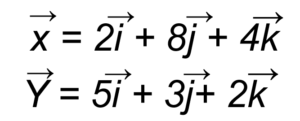
Two vectors are given as:
cross product - cross product calculator
Find the cross product between the two vectors.

Solution :
Given –

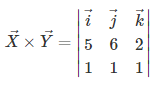
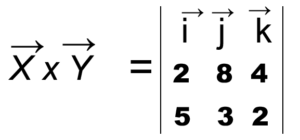
The representation of the above two vectors using cross product matrix method is given by –

On expansion,
cross product - cross product calculator

The final answer obtained is,
cross product - cross product calculator

Problem 2 :
Two vectors are given as:
crossproductcalculator.org
Find the cross product between the two vectors.

Solution :
Given Vectors
crossproductcalculator.org
The representation of the above two vectors using cross product matrix method is given by –
crossproductcalculator.org
On expansion,
crossproductcalculator.org
The final answer obtained is,
crossproductcalculator.org

Problem 3 :
Vector a has magnitude 7 and vector b  has magnitude 2, the angle between a and b is 45° and n is the unit vector at right angles to both a  and b 
What is a × b ?

Solution :
we knew that formula of the cross product is a ⨯ b = |a| |b| sin (θ) n
|a| = 7, |b| = 2 and θ = 45°
Hence,  a × b = 7× 2 × sin(45°) × n  = 12 × 0.8 × n  = 9.6n

Problem 4 :
Calculate the area of the parallelogram spanned by the vectors a=(2,1) and b=(4,3)
Solution :

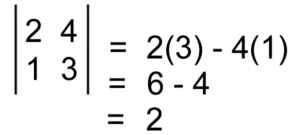
Hence, the Area of a parallelogram spanned by the vectors a=(2,1) and b=(4,3) is  2

  • « Go to Previous Page
  • Page 1
  • Page 2

Primary Sidebar

Recent Posts

  • The Former American Association of Base Ball Clubs
  • Confusion in Physics
  • Marketing is an Essential Part of any Business’ Operations
  • Mastering Mathematics: Top Online Tools to Boost Your Math Skills
  • Effective Strategies for Improving Student Math Performance

Footer

About us

Our free online calculator helps you in solving complex vector arithmetic problems such as finding the cross product of two vectors, this is a tool that helps you master the trick of performing the cross product of both 2 and 3 vectors.

Important Links

  • Terms and Conditions
  • Privacy Policy
  • About Us
  • Contact Us

Social Media

  • Facebook
  • Instagram
  • Pinterest
  • Twitter

Copyright © 2026 | Cross Product Calculator | All Rights Reserved